Sammy Weaver
03.11.25
/ 27.11.25

Sammy Weaver (Hay-on-Wye, Regne Unit, 1987). El seu primer fullet, ‘Angola, America’ (Seren, 2022), va guanyar el Premi Mslexia al Millor Fullet de Poesia 2021 i va ser finalista del Premi Michael Marks de Poesia 2023. Els seus poemes han aparegut a ‘The Irish Times, Colorado Review, The Moth, Mslexia Anthropocene’ i ‘The Island’. El 2025, va ser nomenada Yaddo Fellow i va guanyar el Northern Writers’ Award for Poetry. És la primera poeta llorejada de Rochdale 2025-26. Compte amb deu anys d’experiència dirigint sessions d’escriptura creativa en entorns comunitaris, educatius i de justícia penal. Originària de la frontera gal·lesa, ara viu en una barcassa als canals de Pennine.
Va estar a Sanià amb:
( 1 ) Diari
( 2 ) Contingut extra
( 1 ) Diari
OPEN WINDOW
‘There was a wolf of course; there is always a wolf’
Fiona Benson
3rd November
A ball smashes into the pine needles, detonating them into the air. A beetle runs for covers as the sky pleats into ribbons of saliva. A mushroom cloud of dust bellows up above the beetle. The corpse on the cliff slumps and seeps. The sea sucks.
Chronicle the fury and delight. Watch a spider slip along the crevice. Sit with the impossibility of creation — say nothing. Stare, mouth slung open like a trap at the green pines. You are a brief passing and the sea doesn’t give a toss. Hand-grenades hold a tummy of shrapnel. Designed to split their skins upon impact and so the world embeds itself into your flesh, wounding you countless times. And so you carry on, bloody and in awe.
I meet an old man with a shock of white hair on the path.
‘Hola!’, we both say simultaneously bumping into each other.
‘De dondé vienes?’, he says
‘Sanià’, we both say simultaneously, his is a question, mine an answer.
‘¿Vives aquí?’, I say
‘Just there. You come?’, he proposes.
A door closes in my mind.
‘Busco un lugar para bañar’, I respond.
He grunts and shrugs, then we part ways. When I glance back at him along the path, his hands are floating mid-air with the weightlessness of tissue paper.
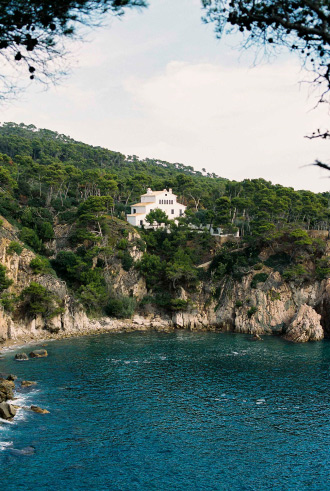
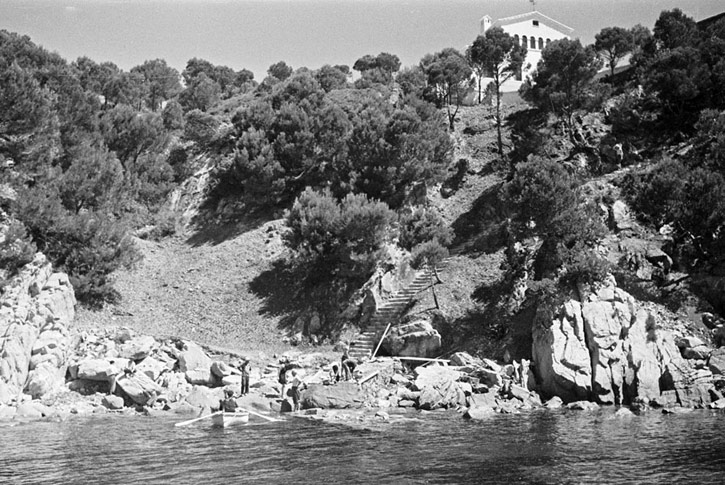
I walk down the small shingle of Cala dels Canyers (Guim’s Cove) into the sea. Pink rags of cloud to the west and the apricot blush of the cliffs. The cold water revs up every engine of every cell. I am in love. The rocks on one side loom over me like sentinels. Floating on my back, I look back at the two white boat huts with their northeathered pine-green doors. I am obsessed with the whorls and eyes of the wood’s grain pressing through the old paint. Everything is pressing upon everything else. Everything is writing everything else. I am easily imprinted. I have fallen very far.
4th November
Finestres means window. Window means aperture. Window means lens, frame, painting, a postcard from the underworld. This window of my studio is double-glazed, two panes of glass enveloping a letter of air. There is a pine-green frame on the world-side of the window. The human-side of the window has shutters painted eggshell white. Further towards world, there is another threshold of mesh. The mesh has very tiny squares smaller than a midge. That’s the point. I watch a fly resting on the world-side of the mesh, its wings trembling with either life or breeze. We do well to keep the world out. All that beauty clawing at us through the window. How would we sleep? Very well. You open the window by unlatching a metal lever upwards, which twists a pole anti-clockwise out of its hooked anchor-hold. All of a sudden, you are tuned into the world’s radio. A million stones slowly screaming. A small bird announcing its own threshold.
There is a thick band of black sea at the horizon. Curved terracotta tiles line the rooftops of the wall. Birds flit between the sun-gilded leaves of the olive trees. The hose pipe is coiled on its wall-fixing like a pale yellow snake. Once, when I was little, maybe five or six, my older brothers said they needed my help.
‘The hose isn’t working, can you look down to see if there’s anything stuck in it?’
I squinted down the black hole only to be struck by the fast flow of cold water. My brothers folded into cackles. My forehead crinkled into a cry. If I were them, I would do the same. So, I peer into the darkness and find the world splashing me in the face. This is something like writing. Fool yourself into the void and a flow will unspool, leaving you utterly surprised, changed.
I am a child poking the strange worm. I ate a worm once. I pulled it from the mud of the back garden and gobbled it up like a hungry robin. Poor worm in the dark socket of my stomach. Annie Dillard describes an Algonquin woman who finds herself alone with her baby after the rest of her village camp have starved during a long winter. The woman finds a small fishhook but no bait:
She took a knife and cut a strip from her own thigh. She fished the worm with her own flesh and caught a jackfish; she fed the child and herself.
So much is said of the world-side of the window. We love to gaze through the frame. The human-side of the window is beset with the domestic paraphernalia of table, chair, sofa, lamp, mug. Drag me savage. I want to sleep with the owls and urchins. I never used to have curtains, preferring the exposure of the night sky and shouty moon stalking about my room as I slept. I slept better of course, closer to the source.
Last night, I saw figures slipping between the pines and heard footsteps rushing up the stairs. Writing is a kind of haunting. Kiss the ghosts. They harbour many gifts. Dead writers are more alive than any of us. For now, the morning light has swaddled the monsters.
I decide I will swim every day, slipping my body through the ocean’s window into the shifting constellations of fish.
Two men are driving towards a house at the edge of a town. They have a shotgun, knife and rope.
5th November
The corpse on the cliff slumps and seeps.
Here, the trees and plants are people stood in their rooms of soil. They just walk slowly, slower.
Theodore Roethke:
I wake to sleep, and take my waking slow.
…
Light takes the Tree; but who can tell us how?
The lowly worm climbs up a winding stair;
…
Great Nature has another thing to do
To you and me; so take the lively air,
And, lovely, learn by going where to go.
The plants are walk slowly, slower and the abejas tickle their chins. This is not anthropomorphism. My surroundings write me. The human slips from centre-stage like all the best novels (if only). The novel is an artefact with our obsession with the human. In In Cold Blood, the Kansas plains are described, but they are the backdrop. The murderers are in the spotlight, not the beetle. The first at a murder scene are always the flies. It is possible to tell how long someone has been dead by the different species of fly making a life on the corpse. The flies are the real subject. They have to be. Release the flies into Sanià and see where they land.
The warm sun is spliced by cloud, casting a dark rim of sea at the horizon. The ocean doesn’t care for horizons as it bulges and snaps at the rocks like a mad dog. I am just as much stone as you are. There is a corpse on the cliff. It has been there for a long time. It is slung on the crutch of its own rotting flesh like a wounded soldier. The corpse is a cactus, an infected cactus, an infected Prickly Pear cactus. There are droves of them collapsed on the cliffs. Whole armies of dying cacti. It is a battleground out there. The cacti are gauzed in a white fuzz like old bandages. At first I think this ashy covering is a fungus. Then, I learn it is cochineal.
I remember my mum telling me how the crimson in lipstick and nail polish is made out of millions of beetles. I must have been about 8 or 9, and I was appalled by the murderous vanity. Cochineal is a scale bug that feeds on the sweet green flesh of the cacti. The cotton tufts visible on the infected are spun by the nymphs to shelter themselves from predators. There is always a wolf. If you pinch these tufts, the white fluff immediately melts into crimson — not the red of fresh blood but the darker red of menstrual blood. These are the females’ soft bodies being crushed. Their bodies are little pouches of carminic acid that deter insect predators. There is always a wolf.
Humans of course love to infect other beings for their own uses. The raping of a cow is just another day on a happy farm. Aztecs were the first to farm cochineal bugs in small hanging baskets around the necks of the cacti. Via ship and tanker, the bugs arrived in Spain and now they are feasting on the green, slow persons slumped on the cliff. Who is the host and who is the wolf?
I write a poem about the cactus. I will visit the dying cactus by Guim’s cottage most days as if it is a dying grandmother.
Two men enter the house through a side door, dousing their torchlight across the family’s belongings.
6th November
What is the word-hoard for this place?
Scrub, red dirt, ant, hormigas, miel, avena, anguila, mar, aloe, pine, colom, wavelet, conejo, cangrejo, bruja, kombucha, trompetas de la muerte, Capote, bolete, blue noise of sea, the friction of a million water particles jostling around the stones.
I will whittle my grief into joy. Split yourself into two, three people and realise you have fled far from reduction; you are more. Divide and conquer the self, or multiply into selves and prosper? You decide. You, the curator, crab and catcher. The seastar starfish twists one of its arms off and walks away. Ed Ricketts quoted by Annie Dillard:
It would seem that in an animal that deliberately pulls itself apart we have the very acme of something or other.
I have renamed writing as sketching, doodling. Grope the unknown for a ghost of form. Sniff it out and slip between angles. Emily Dickinson:
Tell all the truth but tell it slant—
Success in Circuit lies
The potter slaps a lump of clay onto the wheel. The lump sits there like a large sea anemone. A dome of life, latent with form.
What luck to end up on this spit of rock jutting out into turquoise. This place is good because the head can finally doze off and slumber in its fricatives of thoughts like an old cat in the sun. So, the head, brain, mind floats like seaweed. Here you are with your whiskers, belly and nose. I do not owe anything to anyone.
Sat on the bench by the hammock, I am visited by an ant. The ant reminds me of a postman walking briskly this way and that, up and down driveways and paths, the same map every day, a ritual of delivery. I’ve always fancied myself as a postwoman, lover of paths, guardian of letters. No large parcels allowed. Either that or a war correspondent.
7th November
Peach glow on the horizon. I walk to Cala Estreta, a curve of sand with a mob of cats. The beach is an encampment, someone’s place. A permanent beach chair in the middle of curated jetsam. There is a pirate flag and a teddy bear and a circle of stones in the sand. There is an old hut with no windows facing the sea. The old man from the first day? I swim, slipping myself into the cool water. The wind is up and the waves are gently crashing over the rocks beyond me. I am swimming in the shelter of the cove. The large waves fizz into ribbons before they reach me. At once, I am safe and close to danger. The best kind of refuge like storm-rain on a tin roof.
Ode to Quico
Totems
of painted
driftwood
and one
two, three
cats,
you have stolen
the dreams
of many
passers-by
only to burn them
the ash
like little birds
bothering
the sky
8th November
Today I am thinking of jabalí. I remember nights in Galicia and the muffled pop of shotguns. I supposed the gunshot was to scare away jabalí. I often think of those nights. The humans scaring away the beasts but really I wanted to see them grunting right outside my window, turning the earth over for acorns, tubers. I want to come face-to-face with the beast. They are there anyway, may as well open your arms to them. The boarlets of jabalí are called humbugs because of their toffee stripes.
At lunch, Giulio describes a Buddhist ritual called Chöd where devotees send themselves to the forest to be eaten alive by monsters. It is a practice of self-sacrifice; they invite the demons and beasts to feast on their flesh. Sometimes, these rituals are done in graveyards. Often when monsters are faced and acknowledged, they melt into not-so-scary allies. The boundary between self and other, human and beast, becomes a little fuzzy.
Ode to Giulio
I used to work in a prison that had a flock of deer in the grounds. They also kept two goats inside the small yard of Block C. Inside, they kept fish and axolotls and a Giant African Land Snail in tanks. Every Tuesday, I would read short stories and poetry to paedophiles.
The two men are entering every room in the family’s house.
9th November
There is an engine outside by window. És el mar.
There is an orchestra outside by window. És el mar.
There is a monster outside my window. És el mar.
There is a meadow outside my window. És el mar.
There is a mumbling grandmother outside my window. És el mar.
There is a spider with infinite legs rustling outside my window. És el mar.
There is a crackling gramophone outside my window. És el mar.
There is a flotilla of jabalí snorting in the pine needles outside my window. És el mar.
There is a tribe of ants marching outside my window. És el mar.
Giulio, Sole, Guim y yo — we are the Pingu Clan.
10th November
Una tormenta. Rumbling tummy of a small god. Slate-grey sea. Slate-grey sky. Chord-whips of wind lasso the house. Ploma and Sam ladrá. The glow of green pines against the storm-black clouds.
Today you can feel the hum of electricity in all living things. Even the stones are screaming in their cold jackets.
The rain starts up, dashing across the window’s mesh. The half-light of my studio. A god slams a lid down onto the sky. Then starts igniting the fire of an oven.
A storm is a god’s domestic potterings.
Tides of pine needles on the path after torrential rain, the sand pitted.
This morning, when I was swimming at Guim’s cove, I watched the sea race up the fissures of the rocks and thought of Osita’s wound. Osita is my dog. She is a mongrel and always getting into trouble. Just before I left to come here, Osita chased a pheasants over a barb-wire fence, ripping open her stomach. I cleaned her wound with salt water every day and dabbed on manuka honey. I think of her cells stitching back together across the fissure. I think of the cactus being nibbled by all those groping mouths. I think of the eroding cliff and the ‘RISK OF LANDSLIDE’ signs along the cliff path. Everything is becoming everything else. Everything is elsewhere.
Guim’s cove is now a churning soup of storm-spume. This biggest waves so far. The driftwood of whole trees swirl in the water below.
Ode to Guim
Of course,
you are a kiwi
and a turtle
or tortoise
sliding
your smile
from
under
your shell —
11th November
Describing cacti: green-pronged, fleshed-out fork, bulbous and pinched in like an animal balloon. Slabs of green paddles. Green steaks. Batons. A cactus is more limb than flower, more torso than stem.
This one has such fine hairs along its long arms that it looks as if it is glowing from afar. This one has rigid limbs with golden hems that are splayed open.
Pablo describes how the walking trails around Sanià are called Camí de Ronda because people used to ‘do the rounds’ checking for pirates and smugglers coming into land.
Dismember me. Feed me to the beasts. I am done with pretending.
12th November
There is a big yellow arrow-shaped buoy bobbing in a narrow ravine of sea by Guim’s Cove. It stays pretty much in the same place but flips and flaps, collapsing and jerking as the waves come in. It must be fixed in place. If I were to attach a camera to the buoy, it would film the cliff face at every angle possible, never landing on one perspective but shifting this way and that. Writing is this buoy, navigating every angle of a subject to see it differently. The buoy is utterly at the whim of its surroundings, responsive to the smallest shift in the water. Annie Dillard:
How set yourself spinning? Where is the edge — a dangerous edge — and where is the trail to the edge and the strength to climb it?
The world is an anchor. My mind is a wayward child. Description is revelation and the world reveals itself — terrible, stark, beautiful.
I swim at Cala Sanià, or ‘Driftwood Cove’, at sunset. Wind skitters across the ocean. There is a jellyfish not larger than my foot floating just under the surface where I enter the water. I almost mistake it for a plastic bag. The tentacles twitch — alive! I swam away, fearful of its whips.
Cold lingers in my fingers after the swim. I watch the sunset — glowing tinders strewn through the pellets of cloud shifting to mauve, indigo-red and candy-floss tufts of pink. I am reading Pablo Nerudas ‘Odes’, those chiselled paths of admiration, those wells of celebration for all living things.
Oda a Ariadna
Alchimista
de Sanià,
bruja
de la cocina —
anguila,
colom,
galta de vaca —
cada criatura
en tus manos
se convierte
en el elixir
más deliciosa
del mundo
Oda a Búho
Where
is you perch
amongst
the pines?
Invisible
but for
the clock-work
boom
of your call
feathering
the
dusk
Oda a Mari
Nadie
ha limpiado
nunca
mi cepillo de pelo —
querida mamá
de Sanià
con ojos
de agua dulce
y una voz
como
arena
desplazada
por las olas
Ode to Nico
Born
on
the
solstice
surrounded
by
darkness
Ode to Inma
Con un tornillo
en tu oreja
me encanta
como
te ríes y te ríes
con la sabiduría
de un cuervo
del inframundo
Ode to Mike
Sipper
of dark rum,
you snooze
whilst the forest
burns —
inside you
a very old sea
runs
Ode to Juan Pablo
Quería preguntarte
sobre La Mar Murena
but instead
I left you
to tend
the flowers —
Ode to Michele
You translate
the silence
in writers
into photons
paper
print —
half
of your visual
practice
is listening —
13th November
Today I swim with snorkel and goggles. I dunk my head into an another country. An arc ahead of metallic fish, a mirror ball, ribbons of glass catching the light. Bigger fish dwell at the seabed. Fish the size of my little toe with belts of teal blue. There is a cuttlebone floating at the surface. Cuttlebones are the buoyant internal skeletons of cuttlefish. Cuttlebones are chalky-white and often have the pattern of wood grain.
I collect five plastic water bottles from the high tideline on the shingle. There also are three sea-battered red roses, drifted from their bouquet, their lovers, to here.
At night, there is a figure stood the other side of the window. The man sways then disappears.
14th November
Up at 7am. I love being awake for the sliding up of dawn. I have always loved dusk, but now dawn too. I have always been too groggy and hungover for dawn. Living this close to the sea is like living next to a giant animal, unpredictable and never still. The sea is loud this morning at Cala Sanià. The border between land and sea is fuzzy with spray. The sea is a mirror, reflection is inevitable.
I am thinking of Louis MacNeice’s poem ‘Snow’:
The room was suddenly rich and the great bay-window was
Spawning snow and pink roses against it
Soundlessly collateral and incompatible:
World is suddener than we fancy it.
World is crazier and more of it than we think,
Incorrigibly plural. I peel and portion
A tangerine and spit the pips and feel
The drunkenness of things being various.
From now on, I will get drunk on things being various.
15th November
Too stormy to swim in the sea today. I walk to Quico’s beach with its shack and scattering of cats. I watch the waves rear up to a glassy blue then snap and tumble, white foam fanning into the air. There is a flotilla of sea birds out in the big waves. They seem perfectly comfortable sat on the raging sea. I will learn from them. I decide to swim in the pool because the sea is more timber yard than water.
16th November
I woke up describing shadows. An oblong of grey ripples on my bedroom wall. I cannot tell whether the light has been refracted off the sea or pool. Pink sails of clouds tacking along the southern sky. Sylvia Plath:
A disturbance in mirrors,
The sea shattering its grey one —
After dinner, swam in the pool. Giulio jumped in. Swimming in the pool is like having a cup of tea with an alien, lovely and disconcerting. Swimming in the sea is like being born again and again.
Ode to Giulio
Lover of Maccy D’s,
I salute you
for jumping in
and squealing!
How you dance
like an injured
seagull
flapping
through
the stagnant
air of
La Mar Murena —
graceful,
desperate
as I
and as you
meditate
at midday
the sea
against
the shore
chants
Inter! Inter! Inter!
17th November
Snorkelled at Driftwood Cove. Bowls of glitter-fish. A medusa — a mauve stinger? First one, then two, then three, four, five…pulsing in their strange orbits. Each one is a pearly lens with whips of frilly pink. Sylvia Plath’s ‘Medusa’:
Plying their wild cells in my keel’s shadow,
Pushing by like hearts,
Red stigmata at the very centre,
Riding the rip tide to the nearest point of departure
Somehow, sat on her cold granite plinth on a dead star, Plath could view the world with steely accuracy. No better verb than ‘plying’ for the action of the jellyfish.
18th November
At Driftwood Cove, the sea plugs and swills around the rocks. The sound of the water filling and draining the throat between the boulders is hollow and corked. The reeds rustle. The coast is collapsing in on itself. Pines uprooted from the soil. Midges drift between their mid-air rooms. Little snails sequin the rocks. Thick veins of quartz in the granite. A cormorant crucifixing the rocks.
I swam in the pool under the pin-prick stars. The pines above rippled by the water beneath so that everything appears as it is — mutable.
I count syllables in my sleep.
19th November
The sea is quiet this morning. Dawn-dipped leaves of the olive trees.
Ode to Ocean
Ocean,
here’s talking
about you!
Goodness
knows
how deep
this grief
goes down
with your villages
of fish
and your trinkets
of shells.
You are
a grave
and I
am a midge
at your surface.
Ode to Soledad
Sol
y soledad,
Queen
of Pachanga
& Jenga,
Patron
of Penguins,
your dance
so beautifully
subtle
and grounded
that even
the earthworms
find their rhythm
and join in
20th November
Up for sunrise. Strong winds from the land across the sea. Herds of ruffled water galloping away like migrating animals. The wind is only visible by what it touches. The wind’s hands press onto the ocean and a momentary disc of ripples appears. The blazing sun for a minute before slipping under the meringue topping of clouds. Two cormorants scooting a foot above the water, perfectly linear as if there beaks are threaded into some invisible weave.
I snorkel at Guim’s cove. No fish. Nothing. No life. Just a swaying graveyard. I swim further out and a sudden shoal of tiny fish bolted with blue. A bowl of twenty jellyfish. Moon jellyfish? If so, their sting is mild. Seamus Heaney:
Don’t have the veins bulging in your biro.
My poems are stacked with images. I need to loosen, let one powerful image breathe throughout the poem. I need to free my voice of poetic technique.
Still, there is a man lingering outside the window.
Still, a man dominates, unaware of his power. The subtle and persistent comments that undermine a self. I begin to internalise the belittling until I realise what is going on. Edna St. Vincent Millay:
I, being born a woman and distressed
By all the needs and notions of my kind,
Am urged by your propinquity to find
Your person fair, and feel a certain zest
To bear your body’s weight upon my breast:
So subtly is the fume of life designed,
To clarify the pulse and cloud the mind,
And leave me once again undone, possessed.
Think not for this, however, the poor treason
Of my stout blood against my staggering brain,
I shall remember you with love, or season
My scorn with pity, —let me make it plain:
I find this frenzy insufficient reason
For conversation when we meet again.
21st November
Slept bad. Any wonder. Walked with sheepdog Sam to Platja de Castell. High blue sky. Deserted beach. I swam, Sam sat on the beach watching. The wind is whipping the sand against my ankles when I get out. Returned on the coastal path. I love the woods here. I sit watching the sun arc and tickle Sam’s tummy.
I don’t want a heady, clever poetics. I want a bodily, from-the-gut poetics. So much of contemporary poetry is heady, like mini essays, empty with abstractions. They leave me feeling cold. Post-capitalism leaves me cold. I want poetry to be a balm against the detachment.
Ode to Sam
You watch
Ploma
watching
the ball
and for that
you are
more writer
than us all
Ode to Ploma
Ploma,
you’re a crack addict —
though fairing
more beautiful
with your coat
of muddy silk
22nd November
I walk further north along the coast past Quico’s beach. At Cala Bona there is a naked man balancing a pebble on a stack of larger pebbles on a branch of driftwood. The beach is decorated with many more of his sculptures. I feel like I have walked into someone’s living room. I want to gawp at the mantel piece of trinkets, but feel like I’m being nosey. He has the deep bronze of a man who has soaked up decades of naked sun.
I remember sunbathing on a nudist beach in Portugal with a female friend. We had found a little nook under the cliff for relative privacy. We were chatting and laughing when a man arrived in front of us, naked and wanking himself off, as if we’d be pleased by his free show. We told him to piss off and felt utterly violated. When things like that happen, I imagine a woman doing the same, wanking in front of strangers without consent. It is interesting that I have to perform this gender-switch experiment in my mind to truly see the absurdity of the act.
The naked man arranging pebbles and the wanking man are wholly unrelated of course.
The naked man is now standing on the rocks that jut into the sea, one hand shading his eyes from the sun, the other hand on his hip.
A silver petal whizzes above the beach — a dragonfly.
I swim at sunset at Guim’s cove. I am only in a few minutes when I realise the sea has turned into a stream, a small river. The cove is usually calm, but today there is a rip current funnelling between the rocks out to sea. I panic for a second and then remember to swim sideways out of the sea-river. I grab onto a rock and haul myself up and out.
23rd November
I read some of Emily Dickinson’s poems from the tome of her collected poems from the library. Her line breaks, even the space between words, are hinges allowing for doors of meaning to open and close.
I watched a fishing boat this morning. The boat was more rickety shed than boat — a top-heavy plywood box drifting on the water. If a big wave rolled in I’m sure the boat would just topple or sink in an instant. A fisherman comes out of his cabin and peers over the side as if he has lost something.
I swim at Platja de Castell and the plunge snaps me open. Gerard Manley Hopkins’ words resurrect the sunset:
Plum-purple was the west; but spikes of light.
Spear’d open lustrous gashes, crimson-white;
24th November
If you sit with yourself for so long, you will slip through boredom into new territory.
I am wondering how I’ll maintain my daily writing routine once home on my narrowboat. I have a tiny ‘spider cabin’, the only space that might get close to ‘a room of one’s own’. I share the rest of the boat with Adam. The spider cabin is no bigger than a small cupboard and freezing in winter. Spiders love to web the portholes with industrious zeal so the world outside is veiled by their white gauze. Annie Dillard:
The materiality of the writer’s life cannot be exaggerated.
I don’t want to swim today. It’s cold and I feel like staying dry. I tell myself ‘there are always gifts’. I walk down to Guim’s cove but the sea is too choppy so I decide to swim at Cala Estreta, Quico’s beach. The water is getting colder every day as winter shuts like a trap. There is a fisherman on the rocks just south of the cove. He seems bemused by my mission to swim off the derelict curve of sand. When I dip my head under with snorkel and goggles, there are plate-sized oval fish nibbling at the submerged rocks. With each lurch of wave towards land, they flap up like sheets of tin foil.
I love the sleepy sway underneath. There is a lot of seaweed suspended in the water, and along with the fish, we all gently see-saw back and forth. There is nothing more thrilling than peeling away the human world to join the liminal slumber beneath the water. I am a baby rocked in the vast cradle of ocean.
A seagull is sat on a rock in the middle of the sea. Its white breast feathers are ignited by the last rays of sun.
25th November
Up early, held by unthinking routine. A lid of lilac cloud over the sunrise. Damascene sea below. I am thinking about the blade of space taken up by each pine needle. I am thinking about the pocket of air surrounding each pine needle. A line of words is a pine needle that grows and grows and then falls.
Over the past week, I have been writing poems about my dead dad. He died of Alzheimer’s, aged fifty-four when I was thirteen. A strange voice is welling up in my mouth, mythologising him. It seems Sanià and daily swims have allowed me to go to a place I have always been too scared to go. The beast was not so scary after all. Playful in fact. Writing about my dad’s slow demise into memory loss and eventual death can be playful. Father as myth — I have found a mask to speak with.
At his funeral, I got drunk. Thirteen years old and drunk at my dad’s funeral. Only recently have I realised just how wrong that is. A child grieving the death of her father, drunk. This year, after twenty years of heavy drinking, I decided to stop. Maybe that’s why I am starting to write about my dad, I can finally process the grief without intoxication.
A seagull zips along a seam in the sky. I watch the disc of sun shimmering on the water and a line of blue ink at the horizon. The sunrise is tinting the world opal orange and pearl of oyster shell. The disc of sun welded on the sea narrows into a spotlight as the clouds shift.
Dad taught me to brave the wild waves of the Atlantic off the north Cornish coast. I think of how the space his body inhabited in his grave had been taken over by earth.
Dad loved the sea.
26th November
Today, I walk the whole day to Cala Estreta then beyond along the coast to Calella de Palafrugell. A fierce Tramontana wind blows from the north. I find a sheltered nook out of the wind and think that really this Costa Brava November is a lovely English summer. Everyone is complaining about the cold. Ice on the inside of my portholes is cold.
I can hear the wind pewling above my hidey-hole. The wind whips the sea spray off the waves that smash into the lighthouse. These watery whirling dervishes twirl ever-tighter before fanning out into nothing.
When I swim, the fish are different here to the other coves. Spear-shaped fish girdled with electric turquoise.
Calella is mostly deserted apart from a few restaurants open on the water front. I walk up to the garden of Cap Roig. Again, deserted. The Tramontana wind must have put people off. In the cactus garden, there is a cactus over fifteen feet high. It has supported by a long stick to keep to from toppling. It is the fleshy spine of the sky.
27th November
Mist racing from the land out across the sea, veiling the world in its quiet reprieve.
Mist racing from the land out across the sea, veiling the world in its quiet reprieve.
Michele runs up the stairs and says ‘chicos, you need to pack all your things in case we need to leave’
‘What?’ I reply, confused.
Our final day is tomorrow.
‘There is a fire,’ Michele answers.
I start to pack my things then I look out of my bathroom window. The mist racing from the land out across the sea is smoke. The forest is on fire.
I have just finished Leila Guerriero’s book A Difficult Ghost: Searching for Truman Capote and she describes how Truman fled Sanià because of a forest fire, grabbing his manuscript along with reams of notes and interviews that underpinned his book In Cold Blood. The written worlds of books and the lived life are crashing together in shocking ways. I pack quickly and drag my case outside. Giulio isn’t in the house, he went for a run to Platja de Castell. He is heading back along the coastal path, right into the fire. He turns back and manages to get back to us along the road. The firefighters let him through the blockade.
From midday until 6pm, we watch the forest burn. The smoke veils the sun, casting a strange twilight over us. The strong wind is pushing the flames quickly out across the hillside above Cala Sanià towards the sea. The flames tumble down the cliff, nesting like fire-birds on the ridges where tinder has collected. I can hear the wood crackling as the fire advances closer. A pigeon presses into the wall of smoke, arcs back around, presses in again. We are not allowed to leave as it is too dangerous to drive along the road.
Mike, the chef, continues unfazed to cook us roast pork with butternut squash. A few hours into the blaze and we sit down to a feast with sirens and the shadow of the helicopter overhead. After lunch, Mike snoozes on the sofa in the living room. It is not that he doesn’t care, he is too old a soul to be flustered, even as the world burns around him.
What does happen to the animals? Sure, my idealism imagines them all fleeing to safety, not curling up in their burrows as the flames lick at the opening. Not running away from flames into flames, nor vaporising in an instant. I think of the mice. I think of the worms, the snails, the praying mantis, the owl’s nest in those pines.
I think of the cave in those woods, perfectly shaped to sleep in, now full of smoke.
Five firefighters appear right in the middle of the raging flames, silhouetted on the cliff edge. Now, three planes soar low overhead. One small plane looks like it is surveying the fire, then there is a helicopter that unloads a sack of water, and a yellow plan that sprays a long wall of water. I can hear an electric chainsaw cutting into the trees as the firefighters create a fire break between us and the flames.
We have a good view from the other side of the cove. It is a terrible film. Whorls of smoke cascade down the cliff. Mari and I agree that we’d rather drown in cold water than burn.
We leave Sanià that evening, a day early, fleeing the fire. On the way back to Barcelona, we see a house burning on the side of the motorway.
I think of the beetle’s sky ribboned with flames.
( 2 ) Contingut extra
Sammy Weaver
03.11.25
/ 27.11.25
Diari
Contingut extra
Diari
OPEN WINDOW
‘There was a wolf of course; there is always a wolf’
Fiona Benson
3rd November
A ball smashes into the pine needles, detonating them into the air. A beetle runs for covers as the sky pleats into ribbons of saliva. A mushroom cloud of dust bellows up above the beetle. The corpse on the cliff slumps and seeps. The sea sucks.
Chronicle the fury and delight. Watch a spider slip along the crevice. Sit with the impossibility of creation — say nothing. Stare, mouth slung open like a trap at the green pines. You are a brief passing and the sea doesn’t give a toss. Hand-grenades hold a tummy of shrapnel. Designed to split their skins upon impact and so the world embeds itself into your flesh, wounding you countless times. And so you carry on, bloody and in awe.
I meet an old man with a shock of white hair on the path.
‘Hola!’, we both say simultaneously bumping into each other.
‘De dondé vienes?’, he says
‘Sanià’, we both say simultaneously, his is a question, mine an answer.
‘¿Vives aquí?’, I say
‘Just there. You come?’, he proposes.
A door closes in my mind.
‘Busco un lugar para bañar’, I respond.
He grunts and shrugs, then we part ways. When I glance back at him along the path, his hands are floating mid-air with the weightlessness of tissue paper.
I walk down the small shingle of Cala dels Canyers (Guim’s Cove) into the sea. Pink rags of cloud to the west and the apricot blush of the cliffs. The cold water revs up every engine of every cell. I am in love. The rocks on one side loom over me like sentinels. Floating on my back, I look back at the two white boat huts with their northeathered pine-green doors. I am obsessed with the whorls and eyes of the wood’s grain pressing through the old paint. Everything is pressing upon everything else. Everything is writing everything else. I am easily imprinted. I have fallen very far.
4th November
Finestres means window. Window means aperture. Window means lens, frame, painting, a postcard from the underworld. This window of my studio is double-glazed, two panes of glass enveloping a letter of air. There is a pine-green frame on the world-side of the window. The human-side of the window has shutters painted eggshell white. Further towards world, there is another threshold of mesh. The mesh has very tiny squares smaller than a midge. That’s the point. I watch a fly resting on the world-side of the mesh, its wings trembling with either life or breeze. We do well to keep the world out. All that beauty clawing at us through the window. How would we sleep? Very well. You open the window by unlatching a metal lever upwards, which twists a pole anti-clockwise out of its hooked anchor-hold. All of a sudden, you are tuned into the world’s radio. A million stones slowly screaming. A small bird announcing its own threshold.
There is a thick band of black sea at the horizon. Curved terracotta tiles line the rooftops of the wall. Birds flit between the sun-gilded leaves of the olive trees. The hose pipe is coiled on its wall-fixing like a pale yellow snake. Once, when I was little, maybe five or six, my older brothers said they needed my help.
‘The hose isn’t working, can you look down to see if there’s anything stuck in it?’
I squinted down the black hole only to be struck by the fast flow of cold water. My brothers folded into cackles. My forehead crinkled into a cry. If I were them, I would do the same. So, I peer into the darkness and find the world splashing me in the face. This is something like writing. Fool yourself into the void and a flow will unspool, leaving you utterly surprised, changed.
I am a child poking the strange worm. I ate a worm once. I pulled it from the mud of the back garden and gobbled it up like a hungry robin. Poor worm in the dark socket of my stomach. Annie Dillard describes an Algonquin woman who finds herself alone with her baby after the rest of her village camp have starved during a long winter. The woman finds a small fishhook but no bait:
She took a knife and cut a strip from her own thigh. She fished the worm with her own flesh and caught a jackfish; she fed the child and herself.
So much is said of the world-side of the window. We love to gaze through the frame. The human-side of the window is beset with the domestic paraphernalia of table, chair, sofa, lamp, mug. Drag me savage. I want to sleep with the owls and urchins. I never used to have curtains, preferring the exposure of the night sky and shouty moon stalking about my room as I slept. I slept better of course, closer to the source.
Last night, I saw figures slipping between the pines and heard footsteps rushing up the stairs. Writing is a kind of haunting. Kiss the ghosts. They harbour many gifts. Dead writers are more alive than any of us. For now, the morning light has swaddled the monsters.
I decide I will swim every day, slipping my body through the ocean’s window into the shifting constellations of fish.
Two men are driving towards a house at the edge of a town. They have a shotgun, knife and rope.
5th November
The corpse on the cliff slumps and seeps.
Here, the trees and plants are people stood in their rooms of soil. They just walk slowly, slower.
Theodore Roethke:
I wake to sleep, and take my waking slow.
…
Light takes the Tree; but who can tell us how?
The lowly worm climbs up a winding stair;
…
Great Nature has another thing to do
To you and me; so take the lively air,
And, lovely, learn by going where to go.
The plants are walk slowly, slower and the abejas tickle their chins. This is not anthropomorphism. My surroundings write me. The human slips from centre-stage like all the best novels (if only). The novel is an artefact with our obsession with the human. In In Cold Blood, the Kansas plains are described, but they are the backdrop. The murderers are in the spotlight, not the beetle. The first at a murder scene are always the flies. It is possible to tell how long someone has been dead by the different species of fly making a life on the corpse. The flies are the real subject. They have to be. Release the flies into Sanià and see where they land.
The warm sun is spliced by cloud, casting a dark rim of sea at the horizon. The ocean doesn’t care for horizons as it bulges and snaps at the rocks like a mad dog. I am just as much stone as you are. There is a corpse on the cliff. It has been there for a long time. It is slung on the crutch of its own rotting flesh like a wounded soldier. The corpse is a cactus, an infected cactus, an infected Prickly Pear cactus. There are droves of them collapsed on the cliffs. Whole armies of dying cacti. It is a battleground out there. The cacti are gauzed in a white fuzz like old bandages. At first I think this ashy covering is a fungus. Then, I learn it is cochineal.
I remember my mum telling me how the crimson in lipstick and nail polish is made out of millions of beetles. I must have been about 8 or 9, and I was appalled by the murderous vanity. Cochineal is a scale bug that feeds on the sweet green flesh of the cacti. The cotton tufts visible on the infected are spun by the nymphs to shelter themselves from predators. There is always a wolf. If you pinch these tufts, the white fluff immediately melts into crimson — not the red of fresh blood but the darker red of menstrual blood. These are the females’ soft bodies being crushed. Their bodies are little pouches of carminic acid that deter insect predators. There is always a wolf.
Humans of course love to infect other beings for their own uses. The raping of a cow is just another day on a happy farm. Aztecs were the first to farm cochineal bugs in small hanging baskets around the necks of the cacti. Via ship and tanker, the bugs arrived in Spain and now they are feasting on the green, slow persons slumped on the cliff. Who is the host and who is the wolf?
I write a poem about the cactus. I will visit the dying cactus by Guim’s cottage most days as if it is a dying grandmother.
Two men enter the house through a side door, dousing their torchlight across the family’s belongings.
6th November
What is the word-hoard for this place?
Scrub, red dirt, ant, hormigas, miel, avena, anguila, mar, aloe, pine, colom, wavelet, conejo, cangrejo, bruja, kombucha, trompetas de la muerte, Capote, bolete, blue noise of sea, the friction of a million water particles jostling around the stones.
I will whittle my grief into joy. Split yourself into two, three people and realise you have fled far from reduction; you are more. Divide and conquer the self, or multiply into selves and prosper? You decide. You, the curator, crab and catcher. The seastar starfish twists one of its arms off and walks away. Ed Ricketts quoted by Annie Dillard:
It would seem that in an animal that deliberately pulls itself apart we have the very acme of something or other.
I have renamed writing as sketching, doodling. Grope the unknown for a ghost of form. Sniff it out and slip between angles. Emily Dickinson:
Tell all the truth but tell it slant—
Success in Circuit lies
The potter slaps a lump of clay onto the wheel. The lump sits there like a large sea anemone. A dome of life, latent with form.
What luck to end up on this spit of rock jutting out into turquoise. This place is good because the head can finally doze off and slumber in its fricatives of thoughts like an old cat in the sun. So, the head, brain, mind floats like seaweed. Here you are with your whiskers, belly and nose. I do not owe anything to anyone.
Sat on the bench by the hammock, I am visited by an ant. The ant reminds me of a postman walking briskly this way and that, up and down driveways and paths, the same map every day, a ritual of delivery. I’ve always fancied myself as a postwoman, lover of paths, guardian of letters. No large parcels allowed. Either that or a war correspondent.
7th November
Peach glow on the horizon. I walk to Cala Estreta, a curve of sand with a mob of cats. The beach is an encampment, someone’s place. A permanent beach chair in the middle of curated jetsam. There is a pirate flag and a teddy bear and a circle of stones in the sand. There is an old hut with no windows facing the sea. The old man from the first day? I swim, slipping myself into the cool water. The wind is up and the waves are gently crashing over the rocks beyond me. I am swimming in the shelter of the cove. The large waves fizz into ribbons before they reach me. At once, I am safe and close to danger. The best kind of refuge like storm-rain on a tin roof.
Ode to Quico
Totems
of painted
driftwood
and one
two, three
cats,
you have stolen
the dreams
of many
passers-by
only to burn them
the ash
like little birds
bothering
the sky
8th November
Today I am thinking of jabalí. I remember nights in Galicia and the muffled pop of shotguns. I supposed the gunshot was to scare away jabalí. I often think of those nights. The humans scaring away the beasts but really I wanted to see them grunting right outside my window, turning the earth over for acorns, tubers. I want to come face-to-face with the beast. They are there anyway, may as well open your arms to them. The boarlets of jabalí are called humbugs because of their toffee stripes.
At lunch, Giulio describes a Buddhist ritual called Chöd where devotees send themselves to the forest to be eaten alive by monsters. It is a practice of self-sacrifice; they invite the demons and beasts to feast on their flesh. Sometimes, these rituals are done in graveyards. Often when monsters are faced and acknowledged, they melt into not-so-scary allies. The boundary between self and other, human and beast, becomes a little fuzzy.
Ode to Giulio
I used to work in a prison that had a flock of deer in the grounds. They also kept two goats inside the small yard of Block C. Inside, they kept fish and axolotls and a Giant African Land Snail in tanks. Every Tuesday, I would read short stories and poetry to paedophiles.
The two men are entering every room in the family’s house.
9th November
There is an engine outside by window. És el mar.
There is an orchestra outside by window. És el mar.
There is a monster outside my window. És el mar.
There is a meadow outside my window. És el mar.
There is a mumbling grandmother outside my window. És el mar.
There is a spider with infinite legs rustling outside my window. És el mar.
There is a crackling gramophone outside my window. És el mar.
There is a flotilla of jabalí snorting in the pine needles outside my window. És el mar.
There is a tribe of ants marching outside my window. És el mar.
Giulio, Sole, Guim y yo — we are the Pingu Clan.
10th November
Una tormenta. Rumbling tummy of a small god. Slate-grey sea. Slate-grey sky. Chord-whips of wind lasso the house. Ploma and Sam ladrá. The glow of green pines against the storm-black clouds.
Today you can feel the hum of electricity in all living things. Even the stones are screaming in their cold jackets.
The rain starts up, dashing across the window’s mesh. The half-light of my studio. A god slams a lid down onto the sky. Then starts igniting the fire of an oven.
A storm is a god’s domestic potterings.
Tides of pine needles on the path after torrential rain, the sand pitted.
This morning, when I was swimming at Guim’s cove, I watched the sea race up the fissures of the rocks and thought of Osita’s wound. Osita is my dog. She is a mongrel and always getting into trouble. Just before I left to come here, Osita chased a pheasants over a barb-wire fence, ripping open her stomach. I cleaned her wound with salt water every day and dabbed on manuka honey. I think of her cells stitching back together across the fissure. I think of the cactus being nibbled by all those groping mouths. I think of the eroding cliff and the ‘RISK OF LANDSLIDE’ signs along the cliff path. Everything is becoming everything else. Everything is elsewhere.
Guim’s cove is now a churning soup of storm-spume. This biggest waves so far. The driftwood of whole trees swirl in the water below.
Ode to Guim
Of course,
you are a kiwi
and a turtle
or tortoise
sliding
your smile
from
under
your shell —
11th November
Describing cacti: green-pronged, fleshed-out fork, bulbous and pinched in like an animal balloon. Slabs of green paddles. Green steaks. Batons. A cactus is more limb than flower, more torso than stem.
This one has such fine hairs along its long arms that it looks as if it is glowing from afar. This one has rigid limbs with golden hems that are splayed open.
Pablo describes how the walking trails around Sanià are called Camí de Ronda because people used to ‘do the rounds’ checking for pirates and smugglers coming into land.
Dismember me. Feed me to the beasts. I am done with pretending.
12th November
There is a big yellow arrow-shaped buoy bobbing in a narrow ravine of sea by Guim’s Cove. It stays pretty much in the same place but flips and flaps, collapsing and jerking as the waves come in. It must be fixed in place. If I were to attach a camera to the buoy, it would film the cliff face at every angle possible, never landing on one perspective but shifting this way and that. Writing is this buoy, navigating every angle of a subject to see it differently. The buoy is utterly at the whim of its surroundings, responsive to the smallest shift in the water. Annie Dillard:
How set yourself spinning? Where is the edge — a dangerous edge — and where is the trail to the edge and the strength to climb it?
The world is an anchor. My mind is a wayward child. Description is revelation and the world reveals itself — terrible, stark, beautiful.
I swim at Cala Sanià, or ‘Driftwood Cove’, at sunset. Wind skitters across the ocean. There is a jellyfish not larger than my foot floating just under the surface where I enter the water. I almost mistake it for a plastic bag. The tentacles twitch — alive! I swam away, fearful of its whips.
Cold lingers in my fingers after the swim. I watch the sunset — glowing tinders strewn through the pellets of cloud shifting to mauve, indigo-red and candy-floss tufts of pink. I am reading Pablo Nerudas ‘Odes’, those chiselled paths of admiration, those wells of celebration for all living things.
Oda a Ariadna
Alchimista
de Sanià,
bruja
de la cocina —
anguila,
colom,
galta de vaca —
cada criatura
en tus manos
se convierte
en el elixir
más deliciosa
del mundo
Oda a Búho
Where
is you perch
amongst
the pines?
Invisible
but for
the clock-work
boom
of your call
feathering
the
dusk
Oda a Mari
Nadie
ha limpiado
nunca
mi cepillo de pelo —
querida mamá
de Sanià
con ojos
de agua dulce
y una voz
como
arena
desplazada
por las olas
Ode to Nico
Born
on
the
solstice
surrounded
by
darkness
Ode to Inma
Con un tornillo
en tu oreja
me encanta
como
te ríes y te ríes
con la sabiduría
de un cuervo
del inframundo
Ode to Mike
Sipper
of dark rum,
you snooze
whilst the forest
burns —
inside you
a very old sea
runs
Ode to Juan Pablo
Quería preguntarte
sobre La Mar Murena
but instead
I left you
to tend
the flowers —
Ode to Michele
You translate
the silence
in writers
into photons
paper
print —
half
of your visual
practice
is listening —
13th November
Today I swim with snorkel and goggles. I dunk my head into an another country. An arc ahead of metallic fish, a mirror ball, ribbons of glass catching the light. Bigger fish dwell at the seabed. Fish the size of my little toe with belts of teal blue. There is a cuttlebone floating at the surface. Cuttlebones are the buoyant internal skeletons of cuttlefish. Cuttlebones are chalky-white and often have the pattern of wood grain.
I collect five plastic water bottles from the high tideline on the shingle. There also are three sea-battered red roses, drifted from their bouquet, their lovers, to here.
At night, there is a figure stood the other side of the window. The man sways then disappears.
14th November
Up at 7am. I love being awake for the sliding up of dawn. I have always loved dusk, but now dawn too. I have always been too groggy and hungover for dawn. Living this close to the sea is like living next to a giant animal, unpredictable and never still. The sea is loud this morning at Cala Sanià. The border between land and sea is fuzzy with spray. The sea is a mirror, reflection is inevitable.
I am thinking of Louis MacNeice’s poem ‘Snow’:
The room was suddenly rich and the great bay-window was
Spawning snow and pink roses against it
Soundlessly collateral and incompatible:
World is suddener than we fancy it.
World is crazier and more of it than we think,
Incorrigibly plural. I peel and portion
A tangerine and spit the pips and feel
The drunkenness of things being various.
From now on, I will get drunk on things being various.
15th November
Too stormy to swim in the sea today. I walk to Quico’s beach with its shack and scattering of cats. I watch the waves rear up to a glassy blue then snap and tumble, white foam fanning into the air. There is a flotilla of sea birds out in the big waves. They seem perfectly comfortable sat on the raging sea. I will learn from them. I decide to swim in the pool because the sea is more timber yard than water.
16th November
I woke up describing shadows. An oblong of grey ripples on my bedroom wall. I cannot tell whether the light has been refracted off the sea or pool. Pink sails of clouds tacking along the southern sky. Sylvia Plath:
A disturbance in mirrors,
The sea shattering its grey one —
After dinner, swam in the pool. Giulio jumped in. Swimming in the pool is like having a cup of tea with an alien, lovely and disconcerting. Swimming in the sea is like being born again and again.
Ode to Giulio
Lover of Maccy D’s,
I salute you
for jumping in
and squealing!
How you dance
like an injured
seagull
flapping
through
the stagnant
air of
La Mar Murena —
graceful,
desperate
as I
and as you
meditate
at midday
the sea
against
the shore
chants
Inter! Inter! Inter!
17th November
Snorkelled at Driftwood Cove. Bowls of glitter-fish. A medusa — a mauve stinger? First one, then two, then three, four, five…pulsing in their strange orbits. Each one is a pearly lens with whips of frilly pink. Sylvia Plath’s ‘Medusa’:
Plying their wild cells in my keel’s shadow,
Pushing by like hearts,
Red stigmata at the very centre,
Riding the rip tide to the nearest point of departure
Somehow, sat on her cold granite plinth on a dead star, Plath could view the world with steely accuracy. No better verb than ‘plying’ for the action of the jellyfish.
18th November
At Driftwood Cove, the sea plugs and swills around the rocks. The sound of the water filling and draining the throat between the boulders is hollow and corked. The reeds rustle. The coast is collapsing in on itself. Pines uprooted from the soil. Midges drift between their mid-air rooms. Little snails sequin the rocks. Thick veins of quartz in the granite. A cormorant crucifixing the rocks.
I swam in the pool under the pin-prick stars. The pines above rippled by the water beneath so that everything appears as it is — mutable.
I count syllables in my sleep.
19th November
The sea is quiet this morning. Dawn-dipped leaves of the olive trees.
Ode to Ocean
Ocean,
here’s talking
about you!
Goodness
knows
how deep
this grief
goes down
with your villages
of fish
and your trinkets
of shells.
You are
a grave
and I
am a midge
at your surface.
Ode to Soledad
Sol
y soledad,
Queen
of Pachanga
& Jenga,
Patron
of Penguins,
your dance
so beautifully
subtle
and grounded
that even
the earthworms
find their rhythm
and join in
20th November
Up for sunrise. Strong winds from the land across the sea. Herds of ruffled water galloping away like migrating animals. The wind is only visible by what it touches. The wind’s hands press onto the ocean and a momentary disc of ripples appears. The blazing sun for a minute before slipping under the meringue topping of clouds. Two cormorants scooting a foot above the water, perfectly linear as if there beaks are threaded into some invisible weave.
I snorkel at Guim’s cove. No fish. Nothing. No life. Just a swaying graveyard. I swim further out and a sudden shoal of tiny fish bolted with blue. A bowl of twenty jellyfish. Moon jellyfish? If so, their sting is mild. Seamus Heaney:
Don’t have the veins bulging in your biro.
My poems are stacked with images. I need to loosen, let one powerful image breathe throughout the poem. I need to free my voice of poetic technique.
Still, there is a man lingering outside the window.
Still, a man dominates, unaware of his power. The subtle and persistent comments that undermine a self. I begin to internalise the belittling until I realise what is going on. Edna St. Vincent Millay:
I, being born a woman and distressed
By all the needs and notions of my kind,
Am urged by your propinquity to find
Your person fair, and feel a certain zest
To bear your body’s weight upon my breast:
So subtly is the fume of life designed,
To clarify the pulse and cloud the mind,
And leave me once again undone, possessed.
Think not for this, however, the poor treason
Of my stout blood against my staggering brain,
I shall remember you with love, or season
My scorn with pity, —let me make it plain:
I find this frenzy insufficient reason
For conversation when we meet again.
21st November
Slept bad. Any wonder. Walked with sheepdog Sam to Platja de Castell. High blue sky. Deserted beach. I swam, Sam sat on the beach watching. The wind is whipping the sand against my ankles when I get out. Returned on the coastal path. I love the woods here. I sit watching the sun arc and tickle Sam’s tummy.
I don’t want a heady, clever poetics. I want a bodily, from-the-gut poetics. So much of contemporary poetry is heady, like mini essays, empty with abstractions. They leave me feeling cold. Post-capitalism leaves me cold. I want poetry to be a balm against the detachment.
Ode to Sam
You watch
Ploma
watching
the ball
and for that
you are
more writer
than us all
Ode to Ploma
Ploma,
you’re a crack addict —
though fairing
more beautiful
with your coat
of muddy silk
22nd November
I walk further north along the coast past Quico’s beach. At Cala Bona there is a naked man balancing a pebble on a stack of larger pebbles on a branch of driftwood. The beach is decorated with many more of his sculptures. I feel like I have walked into someone’s living room. I want to gawp at the mantel piece of trinkets, but feel like I’m being nosey. He has the deep bronze of a man who has soaked up decades of naked sun.
I remember sunbathing on a nudist beach in Portugal with a female friend. We had found a little nook under the cliff for relative privacy. We were chatting and laughing when a man arrived in front of us, naked and wanking himself off, as if we’d be pleased by his free show. We told him to piss off and felt utterly violated. When things like that happen, I imagine a woman doing the same, wanking in front of strangers without consent. It is interesting that I have to perform this gender-switch experiment in my mind to truly see the absurdity of the act.
The naked man arranging pebbles and the wanking man are wholly unrelated of course.
The naked man is now standing on the rocks that jut into the sea, one hand shading his eyes from the sun, the other hand on his hip.
A silver petal whizzes above the beach — a dragonfly.
I swim at sunset at Guim’s cove. I am only in a few minutes when I realise the sea has turned into a stream, a small river. The cove is usually calm, but today there is a rip current funnelling between the rocks out to sea. I panic for a second and then remember to swim sideways out of the sea-river. I grab onto a rock and haul myself up and out.
23rd November
I read some of Emily Dickinson’s poems from the tome of her collected poems from the library. Her line breaks, even the space between words, are hinges allowing for doors of meaning to open and close.
I watched a fishing boat this morning. The boat was more rickety shed than boat — a top-heavy plywood box drifting on the water. If a big wave rolled in I’m sure the boat would just topple or sink in an instant. A fisherman comes out of his cabin and peers over the side as if he has lost something.
I swim at Platja de Castell and the plunge snaps me open. Gerard Manley Hopkins’ words resurrect the sunset:
Plum-purple was the west; but spikes of light.
Spear’d open lustrous gashes, crimson-white;
24th November
If you sit with yourself for so long, you will slip through boredom into new territory.
I am wondering how I’ll maintain my daily writing routine once home on my narrowboat. I have a tiny ‘spider cabin’, the only space that might get close to ‘a room of one’s own’. I share the rest of the boat with Adam. The spider cabin is no bigger than a small cupboard and freezing in winter. Spiders love to web the portholes with industrious zeal so the world outside is veiled by their white gauze. Annie Dillard:
The materiality of the writer’s life cannot be exaggerated.
I don’t want to swim today. It’s cold and I feel like staying dry. I tell myself ‘there are always gifts’. I walk down to Guim’s cove but the sea is too choppy so I decide to swim at Cala Estreta, Quico’s beach. The water is getting colder every day as winter shuts like a trap. There is a fisherman on the rocks just south of the cove. He seems bemused by my mission to swim off the derelict curve of sand. When I dip my head under with snorkel and goggles, there are plate-sized oval fish nibbling at the submerged rocks. With each lurch of wave towards land, they flap up like sheets of tin foil.
I love the sleepy sway underneath. There is a lot of seaweed suspended in the water, and along with the fish, we all gently see-saw back and forth. There is nothing more thrilling than peeling away the human world to join the liminal slumber beneath the water. I am a baby rocked in the vast cradle of ocean.
A seagull is sat on a rock in the middle of the sea. Its white breast feathers are ignited by the last rays of sun.
25th November
Up early, held by unthinking routine. A lid of lilac cloud over the sunrise. Damascene sea below. I am thinking about the blade of space taken up by each pine needle. I am thinking about the pocket of air surrounding each pine needle. A line of words is a pine needle that grows and grows and then falls.
Over the past week, I have been writing poems about my dead dad. He died of Alzheimer’s, aged fifty-four when I was thirteen. A strange voice is welling up in my mouth, mythologising him. It seems Sanià and daily swims have allowed me to go to a place I have always been too scared to go. The beast was not so scary after all. Playful in fact. Writing about my dad’s slow demise into memory loss and eventual death can be playful. Father as myth — I have found a mask to speak with.
At his funeral, I got drunk. Thirteen years old and drunk at my dad’s funeral. Only recently have I realised just how wrong that is. A child grieving the death of her father, drunk. This year, after twenty years of heavy drinking, I decided to stop. Maybe that’s why I am starting to write about my dad, I can finally process the grief without intoxication.
A seagull zips along a seam in the sky. I watch the disc of sun shimmering on the water and a line of blue ink at the horizon. The sunrise is tinting the world opal orange and pearl of oyster shell. The disc of sun welded on the sea narrows into a spotlight as the clouds shift.
Dad taught me to brave the wild waves of the Atlantic off the north Cornish coast. I think of how the space his body inhabited in his grave had been taken over by earth.
Dad loved the sea.
26th November
Today, I walk the whole day to Cala Estreta then beyond along the coast to Calella de Palafrugell. A fierce Tramontana wind blows from the north. I find a sheltered nook out of the wind and think that really this Costa Brava November is a lovely English summer. Everyone is complaining about the cold. Ice on the inside of my portholes is cold.
I can hear the wind pewling above my hidey-hole. The wind whips the sea spray off the waves that smash into the lighthouse. These watery whirling dervishes twirl ever-tighter before fanning out into nothing.
When I swim, the fish are different here to the other coves. Spear-shaped fish girdled with electric turquoise.
Calella is mostly deserted apart from a few restaurants open on the water front. I walk up to the garden of Cap Roig. Again, deserted. The Tramontana wind must have put people off. In the cactus garden, there is a cactus over fifteen feet high. It has supported by a long stick to keep to from toppling. It is the fleshy spine of the sky.
27th November
Mist racing from the land out across the sea, veiling the world in its quiet reprieve.
Mist racing from the land out across the sea, veiling the world in its quiet reprieve.
Michele runs up the stairs and says ‘chicos, you need to pack all your things in case we need to leave’
‘What?’ I reply, confused.
Our final day is tomorrow.
‘There is a fire,’ Michele answers.
I start to pack my things then I look out of my bathroom window. The mist racing from the land out across the sea is smoke. The forest is on fire.
I have just finished Leila Guerriero’s book A Difficult Ghost: Searching for Truman Capote and she describes how Truman fled Sanià because of a forest fire, grabbing his manuscript along with reams of notes and interviews that underpinned his book In Cold Blood. The written worlds of books and the lived life are crashing together in shocking ways. I pack quickly and drag my case outside. Giulio isn’t in the house, he went for a run to Platja de Castell. He is heading back along the coastal path, right into the fire. He turns back and manages to get back to us along the road. The firefighters let him through the blockade.
From midday until 6pm, we watch the forest burn. The smoke veils the sun, casting a strange twilight over us. The strong wind is pushing the flames quickly out across the hillside above Cala Sanià towards the sea. The flames tumble down the cliff, nesting like fire-birds on the ridges where tinder has collected. I can hear the wood crackling as the fire advances closer. A pigeon presses into the wall of smoke, arcs back around, presses in again. We are not allowed to leave as it is too dangerous to drive along the road.
Mike, the chef, continues unfazed to cook us roast pork with butternut squash. A few hours into the blaze and we sit down to a feast with sirens and the shadow of the helicopter overhead. After lunch, Mike snoozes on the sofa in the living room. It is not that he doesn’t care, he is too old a soul to be flustered, even as the world burns around him.
What does happen to the animals? Sure, my idealism imagines them all fleeing to safety, not curling up in their burrows as the flames lick at the opening. Not running away from flames into flames, nor vaporising in an instant. I think of the mice. I think of the worms, the snails, the praying mantis, the owl’s nest in those pines.
I think of the cave in those woods, perfectly shaped to sleep in, now full of smoke.
Five firefighters appear right in the middle of the raging flames, silhouetted on the cliff edge. Now, three planes soar low overhead. One small plane looks like it is surveying the fire, then there is a helicopter that unloads a sack of water, and a yellow plan that sprays a long wall of water. I can hear an electric chainsaw cutting into the trees as the firefighters create a fire break between us and the flames.
We have a good view from the other side of the cove. It is a terrible film. Whorls of smoke cascade down the cliff. Mari and I agree that we’d rather drown in cold water than burn.
We leave Sanià that evening, a day early, fleeing the fire. On the way back to Barcelona, we see a house burning on the side of the motorway.
I think of the beetle’s sky ribboned with flames.
Contingut extra
Sammy Weaver (Hay-on-Wye, Regne Unit, 1987). El seu primer fullet, ‘Angola, America’ (Seren, 2022), va guanyar el Premi Mslexia al Millor Fullet de Poesia 2021 i va ser finalista del Premi Michael Marks de Poesia 2023. Els seus poemes han aparegut a ‘The Irish Times, Colorado Review, The Moth, Mslexia Anthropocene’ i ‘The Island’. El 2025, va ser nomenada Yaddo Fellow i va guanyar el Northern Writers’ Award for Poetry. És la primera poeta llorejada de Rochdale 2025-26. Compte amb deu anys d’experiència dirigint sessions d’escriptura creativa en entorns comunitaris, educatius i de justícia penal. Originària de la frontera gal·lesa, ara viu en una barcassa als canals de Pennine.
Va estar a Sanià amb: